




Capturing data in structured formats is essential for supporting advanced computational use cases, including business and clinical intelligence, population health analyses, and the future integration of Artificial Intelligence applications.
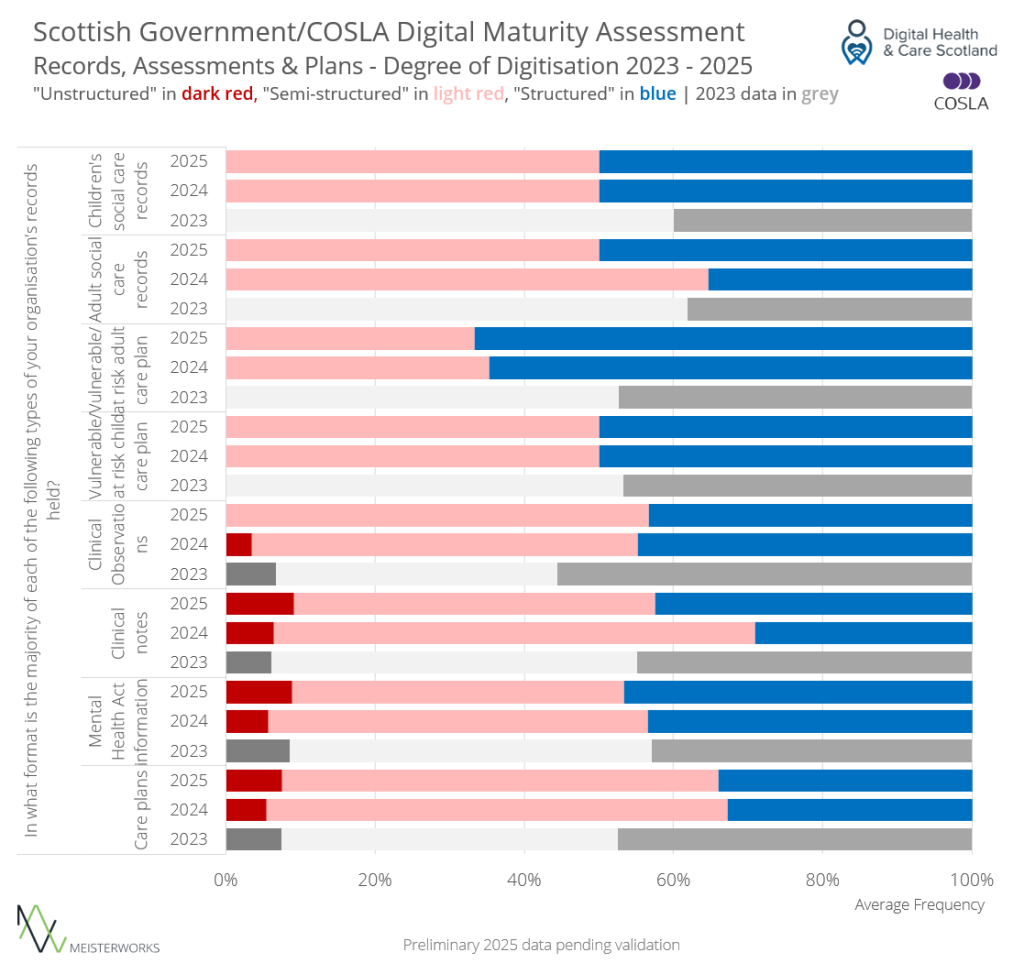
The latest 2025 assessment data demonstrates an encouraging and continuous shift towards these highly valuable structured formats.
When comparing against the 2023 and 2024 baselines, the proportion of structured records has noticeably expanded across core clinical areas, with visible increases within overarching care plans, clinical notes, and Mental Health Act information.
The reliance on purely unstructured data within clinical observations has been virtually eliminated.
The updated data also reveals a significant turning point for social care. The share of fully structured formats for adult social care records and vulnerable and at-risk adult care plans has grown substantially year-on-year, successfully replacing a large portion of previously semi-structured formats. This positive trajectory is not, however, replicated across all domains. The structural formatting of children’s social care records and vulnerable and at-risk child care plans has not changed since 2024, maintaining an unchanged split between semi-structured and structured formats.
The digital management of Records, Assessments and Plans is widely regarded as a critical dependency for many other digital processes. Leadership should be alert to the secondary risks of leaving these gaps unaddressed, including inconsistent data formats requiring workarounds, the creation of dual processes, and constraints on the organisation’s ability to collaborate across its wider health and social care context.
 Contact Author