





Introduction
Innovation within the Scottish Health and Social Care Sector is not only an important component of being ready for the future: at a national level, innovation plays a strategic role in securing the sector’s ability to meet its challenges in a transferable and scalable way, so that all of Scotland can benefit.
The Scottish Government/COSLA Digital Maturity Assessment (DMA) has been tracking the status quo and progress of digitising health and care processes across provider organisations nationwide since 2019. Because it starts with the adoption of digital technology rather than its creation, the scope of the DMA excludes organisational capabilities for innovation.
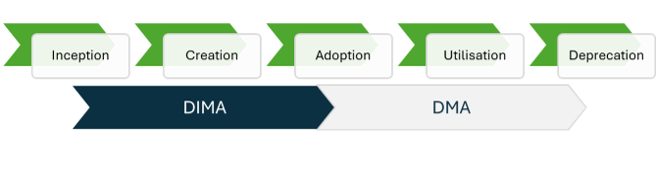
The new SG/COSLA Digital Innovation Maturity Assessment (DIMA) is designed to augment the DMA seamlessly.
Structural Considerations
Although the DIMA is closely aligned with the DMA, it is structured to be a self-contained, complete assessment that produces separate results for its local and national stakeholders. Although there are cross-benefits, innovation is neither a requirement nor a prerequisite, nor a cause for digital maturity, prompting the separate measurement of digital maturity and the reporting on status quo and progress in either field.
Accordingly, the scores and completion of one assessment have no bearing on the outcomes of the other.
Indicators of Digital Innovation Maturity
Much like the adoption of digital technologies into everyday health and care workflows, Digital Innovation is a whole-organisation endeavour; it requires the whole range of asset groups and every type of expertise to work effectively.
The DIMA contains a dynamic question set developed in conjunction with subject matter experts and participating organisations. There are currently 37 questions covering various Readiness, Capability and Infrastructure topics designed to illuminate an organisation’s potential along the innovation value chain:
- Market Potential: Examining the demand, competition, and market size for the innovation.
- Technical Feasibility: Evaluating whether the technology or method is practical and scalable.
- Financial Viability: Analysing the costs, revenue potential, and ROI.
- Alignment with Goals: Ensuring the innovation aligns with the organisation’s mission and strategic objectives.
- Impact Analysis: Assessing the social, environmental, and economic implications.
This question set will continue to evolve as Digital Innovation Maturity in Scotland advances.
Assessment Outcomes
Assessment data along with national comparison values is available to participating organisations via a dedicated analytics portal to help identify and prioritise actions such as:
- Standardising Criteria: Developing a clear set of evaluation metrics applicable across all projects.
- Training Teams: Providing training to employees on best practices and methodologies.
- Leveraging Technology: Using software tools and AI to analyse data and predict outcomes.
- Engaging Stakeholders: Involving diverse perspectives to ensure a well-rounded assessment.
- Continuous Improvement: Regularly reviewing and updating assessment practices based on feedback and results.
Benefits For Participating Organisations
In addition to tracking direction and speed of progress in later re-assessments, organisations will be able to use their initial baseline assessment to determine where they are in relation to the country as a whole, contributing to your organisation’s understanding of:
- Strategic Decision-Making: It helps organisations make informed choices about which innovations to pursue, invest in, or discontinue.
- Risk Management: It identifies potential risks and challenges early in the process, reducing the likelihood of costly failures.
- Resource Allocation: It ensures that time, money, and talent are directed toward the most promising ideas.
- Performance Measurement: It provides metrics to track the progress and impact of innovations over time.
The benefits of regular re-assessments include the use as a standardised management tool for digital innovation capability management, including core aspects for growth:
- Promoting Innovation Culture: Encouraging creativity and risk-taking within the organisation.
- Driving Competitive Advantage: Identifying and implementing breakthroughs that set the organisation apart.
- Optimising Resources: Ensuring investments are directed toward high-impact ideas.
- Building Resilience: Preparing for future challenges by staying innovative and adaptive.
Resource Requirements
The key to successfully completing the assessment is being able to direct the right question to the right person within the organisation. Both assessments are hosted by a specialised, custom-developed assessment portal that provides multiple functions to complete the assessment collaboratively.
For example, the following teams and individuals could be invited to contribute to a response:
- Digital Leads
- Finance Teams
- Senior Management Group
- IT Support Teams/individuals
- Learning & Development
Conclusion
Innovation Assessment is a structured way to evaluate the viability, impact, and potential of ideas and projects. It helps organisations make better decisions about where to invest, what risks to manage, and how to measure progress over time.
Next Steps
If you have questions or if you are interested in using either the Digital Maturity Assessment or the Digital Innovation Maturity Assessment, please contact:
Marion Logan
Policy Team Leader, Digital Leadership & Capabilities
Digital Health & Care, Scottish Government
Marion.Logan@gov.scot
Meisterworks (Contracted provider)
sg@dma.works
 Contact Author