




The 2025 staff survey provides new insights into how the health and social care workforce engages with digital systems and their attitudes towards these tools.
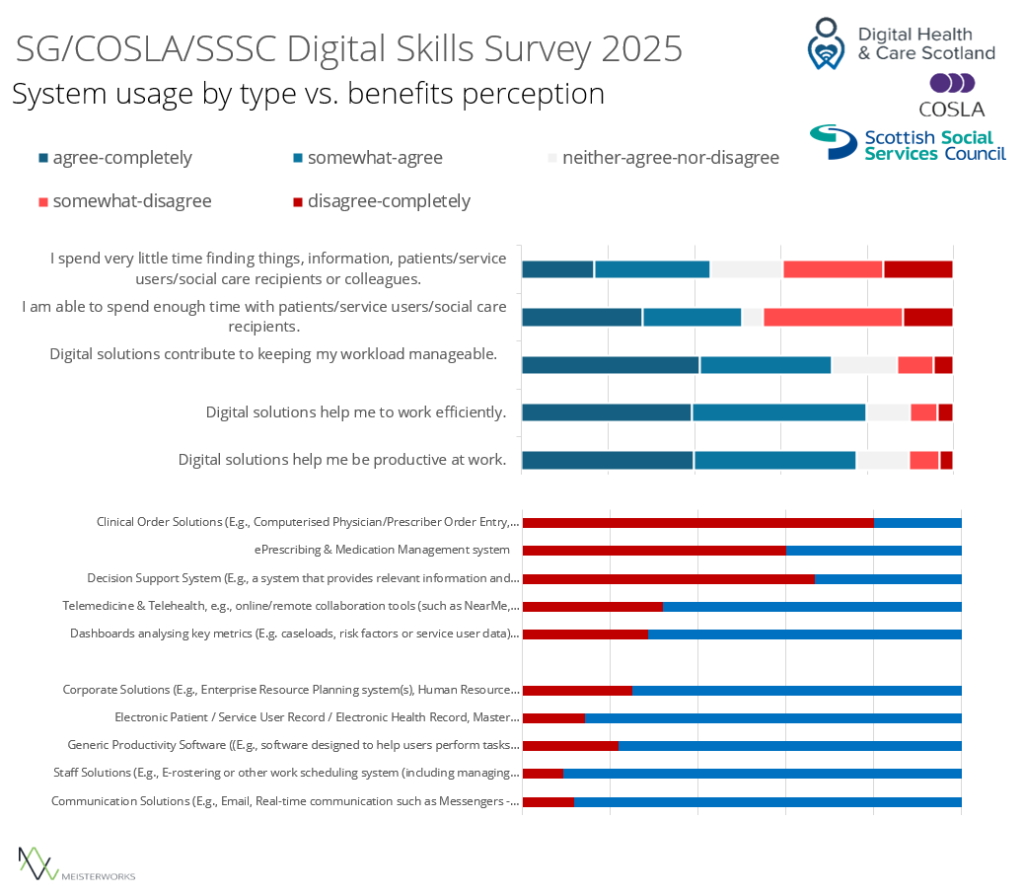
Workforce engagement varies considerably by solution type. General administrative and foundational tools — including communication solutions, staff scheduling systems, generic productivity software, and overarching Electronic Patient and Service User Records — demonstrate exceptionally high levels of engagement and positive adoption. More complex and highly specialised operational solutions encounter significant friction, with noticeably lower engagement and higher frustration reported for ePrescribing and Medication Management systems, Clinical Order Solutions, Decision Support Systems, and analytical dashboards.
Staff attitudes regarding the operational output of digital transformation remain pragmatically positive: staff mostly agree that digital solutions help them work efficiently, be productive, and keep workloads manageable. However, these administrative efficiencies are not always translating into frontline care environments. The ability to spend enough time with patients and service users — used here as a proxy for an overall efficient workplace — is not yet a standard achieved everywhere. The most persistent barrier is the lack of seamless interoperability: a large portion of the workforce reports having to record and enter information more than once. While staff recognise that digital solutions make their work more consistent, efficient, and higher in quality, a proportion reports that navigating them does not make their work more rewarding.
 Contact Author